
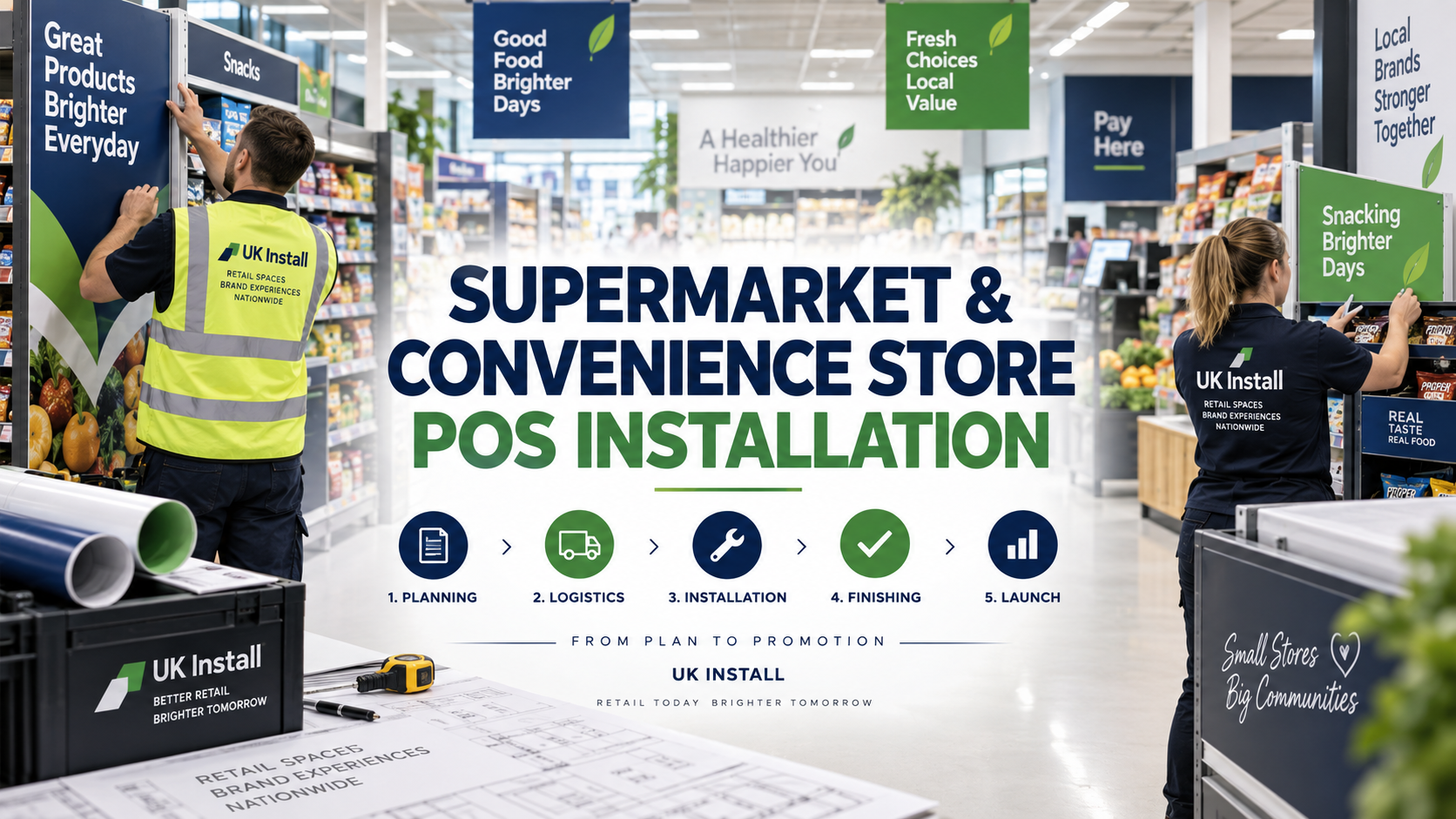
Supermarket POS installation is shaped by one constraint: the store rarely closes. Aisle signage, chiller door graphics, floor decals and window vinyl all have to go in around customers, deliveries and shelf replenishment. The work succeeds when it is planned around trading hours, fitted in the right materials for each surface and repeated consistently across every store format.
This guide covers what gets installed in supermarkets and convenience stores, how installers work safely on a live shop floor, and how grocery retailers keep a campaign consistent from superstore to forecourt shop.
What POS gets installed in supermarkets and convenience stores?
Grocery point of sale covers a wider range of surfaces than most retail. A single campaign can touch glass, painted walls, metal shelving, flooring and refrigeration units in the same store. Each surface behaves differently, so each needs the right material and preparation.
| POS element | Where it goes | Things to consider |
|---|---|---|
| Aisle and category signage | Hanging signs, aisle fins and category headers | Height access and working around shoppers below |
| Shelf-edge and gondola-end branding | Supplier promotions at the fixture | Must not obstruct pricing, labels or stock |
| Chiller and freezer door graphics | Refrigerated glass doors and cabinets | Cold, damp glass needs suitable film and careful preparation |
| Window and entrance vinyl | Shopfront glazing and automatic doors | Sensor zones and door manifestation must stay clear |
| Floor graphics | Entrances, promotional zones and queuing areas | Anti-slip laminate and heavy trolley traffic |
| FSDUs and counter units | Front of store, tills and promotional bays | Stable positioning and clear walkways |
For a wider view of the displays and graphics involved, see our POS installation service.
Why are chiller and freezer graphics harder to fit?
Refrigerated glass is cold, and cold glass attracts condensation as soon as the door opens. Standard vinyl applied to a wet or chilled surface may look fine on the night and then lift at the edges within weeks. Installers need to know whether units can be switched off or defrosted, how long the doors can stay open, and whether the film specified is suitable for low temperatures.
Preparation matters as much as the material. Glass has to be thoroughly cleaned and dried, and the graphic positioned so it does not interfere with door seals, handles or product visibility. If your printer or agency is producing the graphics, it is worth confirming the chiller spec with your installer before anything goes to print.
How do installers work on a live shop floor?
Many large supermarkets trade late or around the clock, and convenience stores often open early and close late. Overnight or out-of-hours installation is the preferred option wherever the store allows it, because aisles are quieter and replenishment teams are the only people on the floor. Our guide to out-of-hours retail installation explains how those visits are organised.
Where overnight access is not possible, the work happens in quiet trading periods. A competent grocery installation team will:
- Segregate each working area so shoppers and staff are kept clear.
- Keep aisles, fire exits and fire-fighting equipment unobstructed at all times.
- Never leave tools, blades or ladders unattended on a public floor.
- Work one section at a time so the store stays shoppable.
- Coordinate with the duty manager on deliveries and replenishment.
- Clear packaging and old graphics as they go.
Store managers also need to know who is coming and when. A clear visit notice, the right risk assessment and method statement, and a team that signs in and out properly all make the night go smoothly.
What about floor graphics in busy grocery stores?
Supermarket floors take more punishment than almost any other retail surface: trolleys, pallet trucks, cleaning machines and constant footfall. Floor graphics need a suitable anti-slip laminate, a properly cleaned and degreased surface, and a realistic lifespan agreed up front. Graphics near entrances also have to cope with water and grit carried in from outside. Our retail floor graphics guide goes into material choice and placement in more detail.
How do you keep a campaign consistent across a grocery estate?
Grocery estates mix superstores, high-street convenience units, metro formats and forecourt shops, and the same campaign has to land in all of them. Windows differ, fixtures differ, and a panel sized for a superstore entrance will not fit a small convenience unit.
The answer is surveying formats before artwork is finalised. A site survey of each store type lets one artwork set be sized into a small number of variants, so every store receives graphics that fit rather than oversized panels trimmed on site. A typical multi-store grocery programme runs like this:
- Brief and site list: the retailer or agency shares the store list, campaign scope and live date.
- Format surveys: representative stores in each format are surveyed for sizes, surfaces and access.
- Artwork variants: the printer produces graphics in the confirmed sizes, packed and labelled per store.
- Scheduling: install dates are agreed with each store, often synchronised overnight so the campaign goes live everywhere together.
- Installation and removal: outgoing campaign graphics come down and the new ones go up in the same visit.
- Photographic sign-off: every store is photographed and reported so head office can confirm compliance without visiting.
For larger estates, our retail rollout service provides one project manager as a single point of contact across every store, with consistent finish and full reporting.
What should grocery retailers include in the brief?
The more an installer knows about each store, the fewer surprises on the night. Useful details include opening hours and any overnight trading, whether refrigeration can be switched off, where the team can park and unload, store contact names, and any landlord or forecourt operator rules. Photographs of windows, chillers and key fixtures help the installer plan materials and time for each site.
Frequently asked questions
Can you install POS while the supermarket is trading?
Yes. Where overnight access is not available, we work during quiet trading periods with each area segregated, aisles and fire exits kept clear, and one section completed at a time so shoppers and staff are unaffected.
Do you install chiller and freezer door graphics?
Yes. Cold, condensation-prone glass needs a suitable film and careful cleaning and drying before application. We confirm with the store whether units can be switched off and plan the visit around that.
Can you cover a whole convenience store estate?
Yes. We run multi-site rollouts across the UK with one dedicated project manager, synchronised out-of-hours installs where required and photographic sign-off for every store.
Do you remove the previous campaign’s graphics?
Yes. Removal of outgoing graphics and cleaning of the surface can be carried out in the same visit as the new installation, so the store changes over in one go.
Do you print the POS as well?
No. We install graphics and displays produced by your own printer or agency, and can advise on sizes and materials before print so everything fits on the day.
Planning a grocery POS campaign?
Whether it is one flagship supermarket or a full convenience estate, UK Install can plan the surveys, schedule the visits and fit your POS around trading. Request a free quote or call 0207 112 8863 to talk it through.